
One hundred nights
Catching up with the Church of Sound's high priest of electronica, Jez Creek

The building seems empty, a shuttered up studio down a back street on the edge of Nottingham’s Sneinton Market. Is this the place? I can’t hear any sounds coming from within but there’s a small A4 event flyer taped to the locked door. After a few investigative forays down the back alleys at the rear of the building, in case there’s a hidden back entrace, I’m back to the front to frantically check the Church of Sound Facebook page, in case there’s been a last minute cancellation. Fortunately, at that point a guy with a guitar case ambles up for a band practice and after I explain the situation agrees to let me trail in after him. Lo and behold, there is an event going on, at a relatively low volume in a small but packed room in the building. I ease my way in, finding the last bit of space in the room to catch the last 10 minutes of Pulselovers’ set. “How did you get in?” asks the amiable sound guy/organiser/provider of cocktail sausages and olives on sticks. I recognise him from the events webpages. This is the man who, more than anyone, has been making it happen since 2014 - Jez Creek.
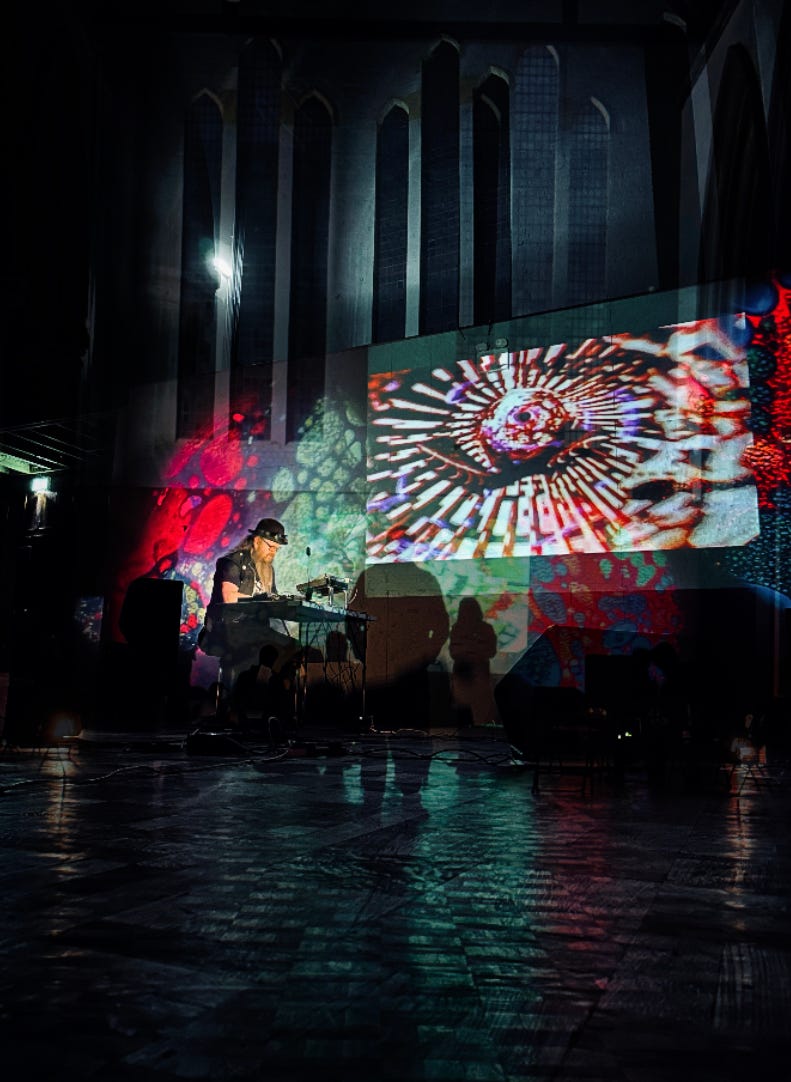
I stumbled across the Church of Sound when desperately searching for interesting events and communities connected to electronic music last month, and got on board just in time to witness its 100th event. The event takes place monthly at the JT Soar studios and has a fully booked lineup of live and improvised electronic music for the year ahead. It’s one of those events that seems to have become an institution without really ever getting on the radar (or not mine, anyway), probably as it seems to have a hardcore of followers who are into the experimental fare on offer. As I’ve learned from my experience, you need to be there on time (or at least, wait until the smoking break between acts) to get in, so don’t turn up fashionably late.
I wanted to find out more about what prompted Jez to start the night and how he’s kept it going so consistently since then, as well as more about his background as an electronic musician, so I fired off some questions that he was generous enough to respond to.
D: How would you describe the Church of Sound and what it's all about?
J: I describe it as a mostly monthly, eclectic evening of ambient/ drone/ experimental/ electro-acoustic/ improvised/ noise/ weird music on the website, in a sense it is also what the name suggests, a place to come together and worship sound, with like minded people in a conducive environment.
D: When did it start and how did that that happen?
J: I used to run a different event called Awakenings, in Burton-upon-Trent, it was for more classic electronic music inspired by '70s/'80s acts like Jean Michel Jarre, Tangerine Dream, Klaus Schulze and Vangelis. In 2012, after 5 years of running this I felt like a change and decided to try and do something smaller, nearer to home and more experimental. It took me a while to find a venue and in the meantime I went on tour in 2013 and ended up playing at Weird Garden, a lovely DIY venue in Lincoln, which also inspired me to keep searching, eventually I found Lee Rosy Tea, which had a room downstairs for events and booked that for the 3rd Thursday of the month as that was a day that was available and held events there until it closed, sadly this closed in 2018, so I moved CoS to JT Soar, where it's been ever since.
D: What kind of artists perform at CoS?
J: A wide range of sonic artists, originally back when it started in 2014 it was pretty much mostly people I knew, some from Awakenings, others friends from the local experimental scene, or who had played experimental events like Rammel Club. Others also seemed to find me somehow and ask to play, probably by word of mouth. Musically, or should I say sonically, I was looking for ambient/ drone/ experimental/ electro-acoustic/ improvised/ noise/ weird music, that was interesting to me sonically and that might not have anywhere else to be performed
D: Are there any particular CoS events that really stand out for you and why?
J: That's a really hard question as there have been 100 now, with very varied performers and many great performances over they years, all of which have been of interest in their own way. I do particularly enjoy the ambient x-church events I've organised in Gainsborough though, as x-church is a great venue and the extended format with 8 acts has been great fun! The next one is in August this year, on Saturday 23rd.
D: What should we look out for from Church of Sound in the coming year?
J: Another eclectic set of performances from both returning performers and new acts.
D: In the current musical ecosystem where streaming for very little return for musicians dominates and a live scene that has taken a battering during Covid, what role do events like CoS play?
J: It's a place for like minded people to come together socially and enjoy performing or being the audience for sounds they wouldn't hear anywhere else
D: It seems like the CoS has brought together and nourished a musical scene of ambient and experimental electronic music. Are there other nodes in the scene, and useful resources for musicians, that those who are interested should look out for?
J: Nottingham's other organiser of experimental music is Rammel Club, they've been going since 2009 and I played at the second one in 2010, they seem to put on more traditional experimental/noise acts, further afield Weird Garden in Lincoln is doing good stuff, as is TQ-Live in Newcastle
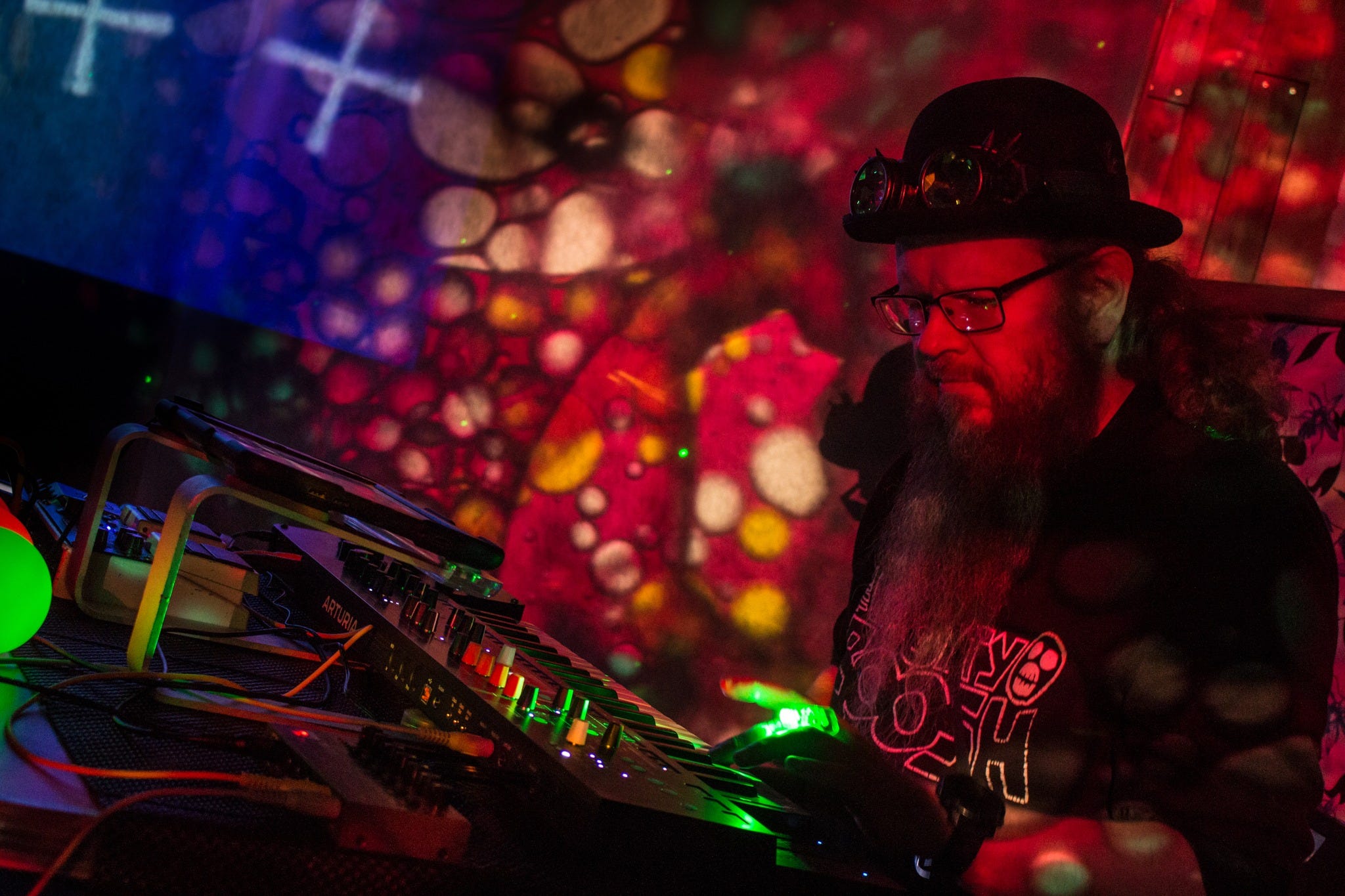
D: You're also a musician yourself with quite an extensive history of releases. Please tell me more about your current projects?
J: Well, I've been doing my solo project as Modulator ESP for 21 years now, but am also involved in lots of collaborations, many of which have also performed at CoS, currently active collaborations include Trapezoid, Infinity Curve, Modulight and Cycling Envelope
D: What inspired you to start making music?
J: I just loved synth music and wanted to make my own, later on I decided that if I made my own music I could make the sort of music I wanted to listen to.
D: You have quite an extensive back catalogue of work. Are there any particular albums that stand out as your favourites?
J: I think I currently prefer the more experimental abstract stuff I've made, some of the more recent of these are Moon Tide, The Machinery of Bliss, Zones In Metal Spaces and Forbidden Dream Zones, I also really like older releases like Floating Metal, Chronovore Incursion Recursion, Sub-Zero, Strange Orbits and Worlds Apart.
D: Which musicians inspire your current work and how?
J: My original inspirations were the aforementioned classic acts from the '70s/'80s, then there was a new wave of acts inspired by these in '90s/'00s that I liked, like Airsculpture, Arc, Ian Boddy, Node and Radio Massacre International, then in the '10s I discovered US synth noise acts like Oneohtrix Point Never, Pulse Emitter, and Emeralds, who also performed at the second Rammel Club back in 2010
D: In your bio on your website you cite a lot of influences from prog rock and the more psychedelic end of electronic music from the '70s and '80s, like Pink Floyd, Tangerine Dream, etc. Do you think these artists still have relevance in an era where music seems to be increasingly dominated by tracks under 4 or even 3 minutes?
J: Probably not for most younger people as they are very unlikely to be exposed to them, but I still think a small number of people will always want something more from music and go searching to find older things that might have inspired newer acts that they are aware of and so find their way back to such music.
D: What gear do you use to create your music and how does that influence what you come up with?
J: Lots of synths, but not all at once, I have quite a few synths I've acquired over the years and I think they all have their own sound and I like improvising with them in different combinations, usually 3 or 4 at a time, as the interactions between the different sounds can be quite inspiring, I also tend to prefer synths where I can easily completely change the sounds as I play them, often coming up with new sounds as I perform, some that will never be heard again!
D: What would you say your signature sound is?
J: I don't really have a signature sound, more like a signature process probably as pretty much all of my music is improvised live using a long delay to loop sounds in an evolving fashion, with the sounds dependent on which of my many synths I'm using for that performance
D: Any releases, gigs or other projects coming up in the future that we should look out for?
J: I'm playing solo at Awakenings in April, now in Rugeley, the Diode Festival in Arnold in June with Infinity Curve, TQ-Live in Newcastle in May and I'm supporting tAngerinecAt at The Chapel in October and playing CoS in December. I'll probably release several things this year, but have no concrete plans yet.
D: The music industry seems to be a very bleak today, with AI generated playlists taking over the big player's sites and very few artists making a living. What's the way forward?
J: I don't really care about the music industry as I'm making music for myself really, I've never had any expectations of 'making it big' as what I do is so un-commercial. I share my music on bandcamp in case anyone else likes it and make CDRs for sale at gigs as people still seem to like a physical product.
D: If you were able to send a message to your teenage self to give them guidance on how to approach music making what would you say?
J: Just have fun and don't worry how long it takes as you'll get there in the end.
Excellent! People like Jez keep everything that's electronic evolving, and he clearly loves what he does. An unstoppable force. Lovely bloke too.
Thank you for the blog.