
Grounded, whilst cosmically out of control
Putting down roots with Bartholomew

The music starts with the metallic rushing sound of a drum stick circling a small red ovoid drum. The brushed metal sound loops over and over and now tones ring out as the drum is struck and, like a scene in a David Lynch movie, the loop continues, even though the orchestra is no longer playing. Soon, synthesised drums weave a lurching rhythm back and forth over the bell-like tones.
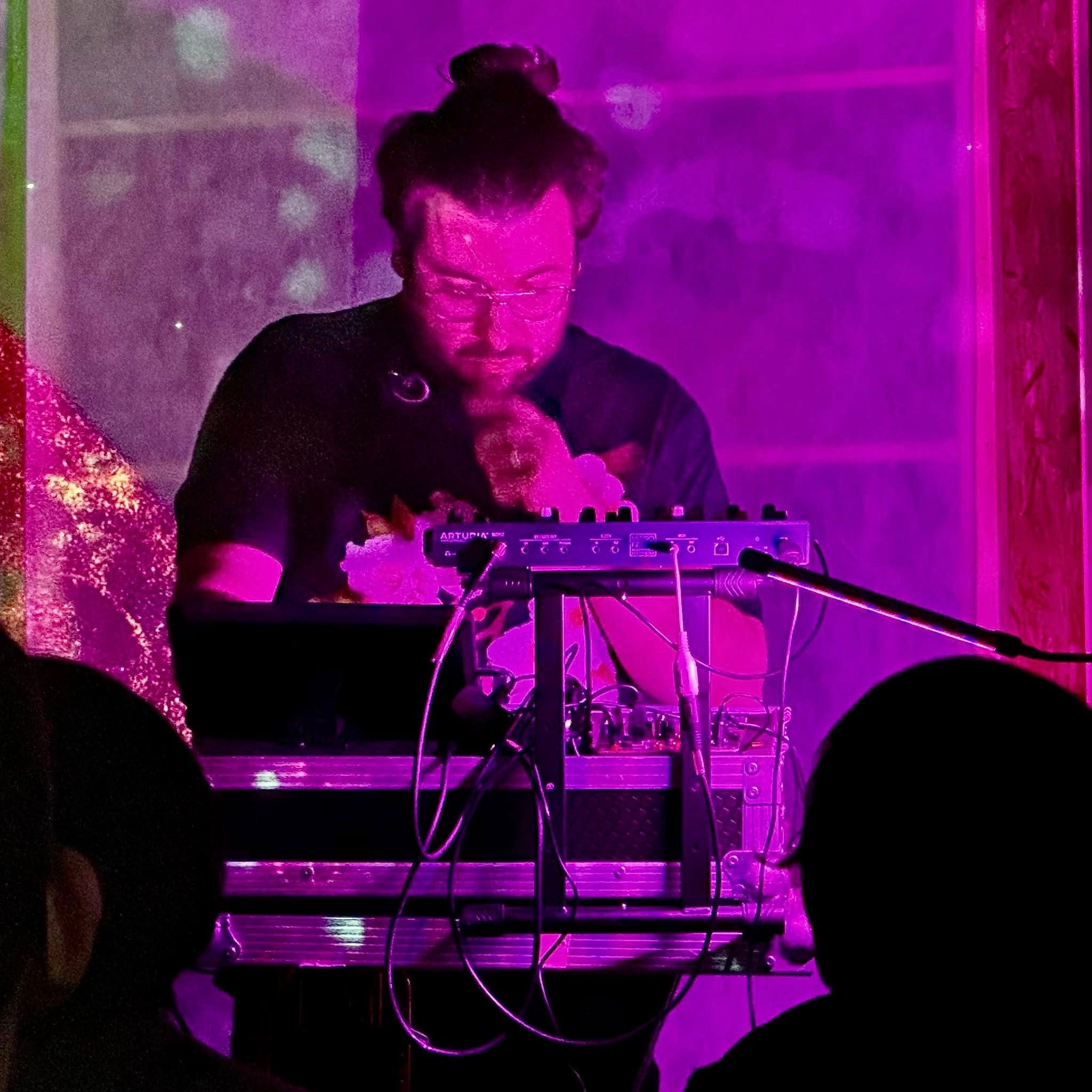
This is (Chris) Bartholomew’s Terrarium, a track from his forthcoming album all about attempting to find stability and structure (as well as accepting that it’s not always possible). As soon as we start our Zoom call he launches into an in-depth account of all of the things he’s been up to since his Church of Sound gig in April and I don’t have the heart to interrupt to ask if I can record straight away…
C: I work with a really fantastic guy called Kunal Singhal who runs Chaos Theory which is an events promotions… He’s a promoter from London who I’ve known for about a decade and we’ve been working together on... Essentially, I took on my first ever full-time job. I’ve been working freelance for the rest of my life and I took a full-time job last September and the challenge for me was… OK, I now have less time to do music things so I need to spend that time in a much more focused way. Essentially, when it gets to 8 o’clock on a Wednesday evening and I’ve got two hours to do whatever it is that I’m gonna do, I need to know, before I hit that time, what is gonna be that activity.
D: Yeah, yeah.
C: So I’m mentally prepared for it, I’m not fumbling around for what I need, I’ve got everything set up. So, me and Kunal check in about once a month on, like, OK, these are the things that are coming up so here’s the things that I need to be focusing on for the next month and that’s gonna be a range of stuff. That’s gonna be, how am I feeding the social media monster this month? What am I doing to progress longer projects? What am I doing to start newer projects? But just having that person to help give that direction once a month is absolutely invaluable. You know, especially when you’re not doing something full-time it has really helped focus that activity. It’s been really good.
D: Fantastic. So, I saw you play at the Church of Sound which was quite a while ago now. I was very impressed with your set so thanks for that. You said during the set that those are fairly new pieces that you were playing? Is that right? Tell me about your set. Tell me about the tracks that you played there and the ones that you played more recently at Cobalt as well.
C: I get to do the thing, one sec. [Hunts for CD] They are all tracks from this, which is my next album which is called Subterranea, which is coming out on Lunar Module which is a little sub imprint of Castles in Space.
D: Ok, Yeah. So the CDs are all ready to go, then?
C: The CDs are ready to go. It’s, essentially, Gordon and Colin from the label who announced the series last week, or the week before? So it’s all ready, it’s ready to go, which is really exciting because that album’s already been done for about a year which is a really new thing for me, having that delayed gratification.
D: I imagine that’s quite hard.
C: Yeah. And I think I have to be… I have found that difficult and to their enormous credit, I think Colin has been very patient with me finding that difficult. [Dan laughs] So that’s really good. I feel very lucky. You know, an album is not a small amount of work and so when you are working with someone on its distribution and promotion, you’re putting a lot of faith in them and sometimes when you’re doing that with a new set of people and when you’re putting your trust in someone new it’s a bit like taking your car into a new garage or something. It’s like “Oh God, are you the person that I want to trust this with?” And I mean, the CDs are gorgeous, the mastering that’s been done for the record is a really wonderful job and I’m so excited to have Subterranea come out on Lunar Module – it’s really great. The record itself is about… I crave stability, which is not necessarily a particularly sexy thing for a musician to… you know. [they laugh] It’s weird. I’m not a particularly a band-y person – I’m more into electronic music but my favourite band through my teenage years was a band called Bloc Party and I think there is a sort of slightly chaotic party, big emotional outpouring sensibility to their music which really appealed to me as teenager and then I couldn’t listen to it through my 20s. Those records have become my “I need to stay awake when I’m driving”, I sing along to those albums because I know them really well. Subterranea is sort of me trying to find the opposite of that chaotic energy. It’s about trying to create a life for myself which is quite grounded and in many ways, quite predictable. I was diagnosed with Borderline Personality Disorder in my 20s and I react to change quite strongly. I have quite a keen reaction and that can be emotional change, it can be geographic, financial, all of those things come with a certain amount of “Oof” and so Subterranea is… The important bit about Subterranea is the trying to put down roots, it’s trying to create the really firm basis for exciting things to grow out of.
D: Yeah, yeah.
C: And I still think that’s a really noble pursuit is trying to create stability but I’ve had to learn to be a bit more, slightly more zen about it and go “OK, yes but you aren’t… this is a really noble effort but be OK with the fact that cosmically you are not in control.” [they laugh] Things can happen and will happen that make you go, “Oh shit, was any of this worth it?” And fortunately, for me, when those things have happened they are surmountable problems and things that don’t have too much of a lasting… ah, a few things which have been “Oh shit, well that’s happened.” But a few of them have been “OK. That’s scary but you can get through it.” So Subterranea is very much a record about a desire for stability and also an acceptance that that’s not necessarily something I have total control over.
D: Yeah it’s really interesting. I kind of feel like that that’s slightly… maybe not in all fields of music but I think it’s unusual to hear that kind of metaphysical concept behind an album these days. I don’t know, maybe it’s that the musicians I hang out with are a bit less philosophical. [they laugh] But I also think it’s interesting that you mention organic images to associate with that kind of album, roots growing and things like that. That was very much the feel that I had from the music that it felt very organic, it felt very alive, like a living, evolving being. How do you cultivate that sort of effect, would you say?
C: Oooh. I really like the point at which acoustic sounds that we know become slightly unrecognisable and, I mean, have you watched any of the Mandalorian?
D: No, I’m not really a Star Wars fan.
C: So, the main theme is by a phenomenal film composer called Ludwig Goransson who also wrote the music for Tenet, the Christopher Nolan going forwards and backwards at the same time film. And I’m a huge fan of Ludwig Goransson’s work but the main musical idea behind the theme from the Mandalorian is basically him playing some recorders not very well.
D: OK [laughs]
C: This is not me trying to disparage him in any way it’s just they don’t sound like… we don’t think that they’re recorders and so I try and, as much as I can, and to be honest I wish I could do it more, is involve a lot of acoustic instrumentation in what I write and so… and even when I’m not specifically working with an instrumentalist in that moment or it’s not an instrument that I’m playing, I’m like, if I can go back and rerecord stuff then I absolutely will and that is… I wouldn’t say it’s laziness on my part. I’m not sure I have the patience for sound design that other people have and a lot of these… you know, I work with a phenomenal cellist called Mark Carroll, and he’s just bought a new cello and I say it’s a new cello but it’s Victorian. And it’s like, OK, yes, I could sit and spend, you know, three days programming a synth patch, or I could book a session with Mark and have 200 years of sonic history plus his amazing talent and the richness and the complexity of those sounds as a source for sonic development and, you know, that’s a really “Oh!” That’s an amazing sound to be able to capture. And so a lot of what I do comes from acoustic instrumentation even if I’m then ripping it to shreds.
D: So sampling actual sounds, particularly instruments then?
C: Yes. Very much so. And there’s quite a lot of… When I’m performing live, I use a lot of granular processes because I quite like the sound of them. To a certain degree, I think what I really like about them is how controllable they are and the balance between the expected and the unexpected that they generate. Being able to have those under my fingers when I’m on stage is a big part of how I try and keep that level of experimental experiments in the live show. With the granular sampling it’s like, “OK, I’ve put in the samples that I know work and I know that I can take them this far in this direction or in this direction and it will all still work” But within that frame I’ve got a lot of movement, I’ve got a lot of places that I can play and that’s really cool.
D: It’s kind of back to that concept again, isn’t it, of you know you’re familiar with the sounds but there’s also that element of you can manipulate them in new ways, create new things that are unpredictable.
C: Oh absolutely. There is a fine line there because I’m not that interested in… I have respect for people who are into that kind of acousmatic kind of composing where you’re trying to separate the sound from its creation, you’re listening to a piece and you’re hearing the sound and you’re trying to divorce it from the physical thing that’s created it and it’s, OK, that’s a concept that clearly needs to exist and I’m sure has a lot of academic usefulness and rigour and thought behind it and that’s totally fine. It’s not for me because I am so invested in, when I am using a sound, it’s generally because that sound has a real… comes from something that I really care about and a good example of that would be there’s a piece on the album, that I played live, called Terrarium and it’s the piece where I play the red UFOy looking tom drum. And that instrument my wife bought for me for Christmas and she really loves it and actually when we have nephews and nieces over they really love it as well and their parents really love it because it is a really beautiful, tactile thing but sonically it’s really calming and it’s a really soothing thing to play. It’s diatonically tuned so you can’t play the wrong note on it really and it has some peculiarities because it’s not terribly well manufactured so the harmonics in it don’t quite sit together but that sound is a really important part of that piece because it comes from that instrument that my wife bought me at a really difficult time in my life, she bought me this thing which creates a lot of really soothing experiences that I’ve engaged various family members with. And for that piece the providence of that sound is a really crucial part to that piece.
D: Yeah, absolutely. I really liked the visuals for your set as well. So tell us more about how you came up with the visuals? Did the music come first and the visuals were an accompaniment or have you always had an interest in visual arts as well?
C: I’ve definitely always had quite a strong interest in the visual arts. I really like modern art and I try to go to galleries as much as I can and it is something I really enjoy but I think the really big turning point was I worked on some shows as a tech that an artist called Tarik Barri was working on and he is an absolute… He codes a lot of his own shaders and has a performance setup that is so clever, the way he’s put it together and I’ve shamelessly ripped off in some of the projects. During the shows I needed to be side of stage in case something happened and the sides of the stage basically put me beside his monitor and I would spend the show just watching what he was doing. I was “OK, how do I do that?” And I wouldn’t say I’m that much closer to knowing, 10 years on. So, I’ve done a lot of… One of my happy places is, if I have a spare hour, I will go and look on Youtube for Touch Designer, which is a generative visuals environment, I’ll go and look for Touch Designer tutorials and go, “OK, someone’s made something that I like the look of and made a video on how to make it.” I will sit and, almost like Bob Ross painting, I will work through it with them and I really love that. The difficult thing about that is a lot of what comes out of it, those processes can be quite abstract and can be really different between each other and one of the things that I really wanted for the show is to have a very cohesive visual language where everything kind of feels like it’s in the same world. So I came up with a very deliberate pipeline with this which was I made an Instagram reel for but basically it starts with thinking about what the record is about. And some of them did come from really strong visual places, so Worm Knitting for example. I wanted that feeling of worms churning earth and knotting over each other. Finding stock footage that kind of fits that idea in my head and then that all goes through… I created a bunch of animations, fairly geometric just using three colours, red, green and blue and black as well and then those create masks so that where the red is in the animation, that’ll let through one piece of stock footage, where the blue is that’ll let through a different piece. And that is just a way of… What I found was that a lot of this stock footage, because it’s footage of real things, there’s a lot of complexity to those images and if I was gonna add anything or disrupt them in any way, it needed to be quite simple otherwise I’d have just ended up with visual vomit. So we end up with a composite of three pieces of stock footage moving around each other which then goes through a whole load of Touch Designer nonsense that makes additional glitchy movement and pixel spotting and that all happens in black and white and then it goes through some colour amps that basically assign pixels. If it’s this shade of grey then it’s gonna be in this colour, if it’s this shade of grey then it’s in this and that, essentially allows me to really define what the colour space is for each piece and be very specific about that, even when I’m using lots of images from different sources. For the gig at Church of Sound I was prototyping that process because I hadn’t fully expected… My plan was to really focus on that show and then I had an email from Jez saying “If you could please send your visuals over to me by two days before,” and I was like “Well I don’t have any visuals for the show…” So there were a few very late nights putting that together as a proof of concept and then for the Cobalt show it was like, I’ve got two weeks, I know conceptually this works – I’ve got to go back and really… So for Church of Sound there was basically one visual running for each piece. For Cobalt there was a visual for each section of each piece.
D: Oh wow, OK.
C: So it’s sort of, like, it’s a chunk more work but everything feels much more reactive and much more synced to the music.
D: Fantastic. Well it worked really well, even the prototypes so don’t worry [they laugh].
C: Good.
D: What would you say are your musical influences?
C: We’ve touched on it briefly but a lot of the music that I find really exciting right now and probably for the last 10 years or so has been music for film and TV. I was a real snob about it, especially when I was doing my undergrad and that partly came from a… nothing had really caught my ear and the first film music I really became aware of was James Horner’s score for Avatar and my feeling about that at the time was, “OK, you’ve got a big orchestra, you’ve got a big percussion section – well done, why didn’t you do something more interesting?” That kind of level of precocious snobbery that I hope I’ve grown out of slightly, since then. And then came along a short-lived Channel 4 series called Utopia with a score by Cristobal Tapia de Veer who most recently wrote the music for White Lotus and has been having a big falling out with the director quite publicly. I have no stake in it, I just love Cristobal Tapia de Veer’s music. His score for Utopia absolutely defines the feeling of that series to me. It combines some really weird instrumentation, lots of kind of latin dance rhythms, so bits of rumba and calypso and different vibes through that and there’s just loads of samples from a Stockhausen vocal piece called Stimmung just interweaved in it and it’s just brilliant. It’s mad scientist level genius and when I head that I was like, OK, clearly this is a world that I need to be paying more heed to and I think what film music is doing for me at the moment is there’s a huge amount of experimentation that seems to be going on behind the scenes and some really quite high concept-y things going on. So, a great example of that is Hans Zimmer’s score for Inception which uses “Je ne regrette rien” timestretched and then reorchestrated as… he’s taken this piece of music, he’s timestretching it and then creating these orchestral pieces based on those timestretches and depending on what level of dream they’re in it’s being timestretched different amounts so… [they laugh]
D: Mad genius again [laughs]
C: That ticks all of my boxes. It is people who are combining acoustic instrumentation with some really wild electronic experiments with, still terribly unsexy a bit of a focus on writing a nice melody and doing some interesting harmonic things and finding those people. In the UK the person I’m most in awe of is Hannah Peel whose work I think is stunning. She did a beautiful album with a poet called Will Burns called Chalk Blue Hill that is sonically beautiful and emotionally devastating and seeing that live was a bit of a watershed moment, really stunning. And then there’s all the people in Newcastle doing really exciting and wonderful things. When I moved up here the first thing I went to was seeing a band called Archipelago. I don’t know if they would still define themselves as jazz but it’s a jazz double-bassist called John Pope who’s a very good friend of mine now, a reeds player called Faye MacCalman who’s been on tour supporting Richard Dawson and one of my favourite drummers of all time, Christian Alderson from The Unit Ama and they’re phenomenal. I think Newcastle has an incredibly rich music scene at the moment and very much a lot of people trying to do some really interesting things, on their own terms without necessarily a huge amount of financial support from institutions. There’s some kicking around and I don’t necessarily feel tuned in well enough to make any kind of sweeping statements about it but there’s a lot of people trying to do really interesting things on shoestrings and that in some ways is sad because it’s like, “Oh my God, if only you had a grant,” but is also incredibly heartening that people are kind of…
D: Just doing it anyway.
C: Yeah, people are trying to make interesting things happen.
D: I was gonna ask you, you were talking about the inspirations you have and the effect they have on you but what kind of effect would you like to have on listeners? What effect are you aiming to have when you perform a piece?
C: Oh that’s a… [laughs] a really difficult question. I mean a live show is slightly different but when I’m writing a piece of music I am often doing my utmost to not think about what anyone else is gonna think about it. I think I have a very loud critical voice, I dunno, I don’t know how it compares. It feels really fucking loud and so I am, whenever I’m writing music I’m doing everything I possibly can to hold off that critical voice for as long as possible and come up with something and when I’ve come up with that thing there will get to a point, often, where I will cajole my wonderful wife to come and sit and listen to something. She is not musical by her own…. And she doesn’t necessarily particularly care about music, certainly not to the same level of minor obsession that I do. So, as a sort of gently dispassionate audience, she’s a really good person to just sit and watch her face and see whether it’s… how it’s landing with her. And there are pieces, I know, that I’ve written and she loves and there are pieces that she finds very, very difficult and there’s a piece at the end of Moorbound called Gaits that is essentially all about walking our first dog across Newcastle’s Town Moor and my proudest moment as a musician and human was I didn’t have to really tell her what that piece was about for her to get, OK, this is how it felt for you to walk Marley across the moor, so that’s a really special thing. Now, when it comes to performing electronic music, that is a really hard thing to make look interesting.
D: Yeah, yeah. Absolutely.
C: And I think it’s something I’ve been gently obsessed with since my teens. I came into electronic music via DJing. And obviously, DJing has such a, certainly now, well understood visual language of, this is the gestural language of DJing and these are what these gestures mean. So that was a route in but then it was really trying to… what am I trying to say? I have seen a lot of people performing electronic music and it’s something I do seek out and something I do see a lot of and if I don’t feel like someone hasn’t put any effort into how that performance communicates the music I get slightly grumpy. I’m not gonna lie, I do not care what is happening on that laptop screen, if you’re not making any effort to engage me on a human to human level… give me something to look at and sell it to me and that is always the case, I’m always trying to think about when I’m performing the music live, what are the gestures that I’m employing throughout this piece? Is there a gestural language that I can set up so that the audience has some understanding of what I’m doing? How can I incorporate the things that they will, instinctively, understand, so playing the cornet in the set is a really crucial thing because it’s immediately a way of me going… and whatever set I’m playing, I generally start by playing the cornet and then manipulating that sound because it immediately tells the audience that what they are hearing comes from real things. Or, certainly, that’s what I’m trying to do with it. So I am playing live, I am trying to communicate something of why I’ve written this music, why I think this music is interesting and valuable to me and how I think it embodies some level of shared experience. So I think a lot of people probably seek out some level of stability in their lives and using the music as a way of being able to talk about some of those things. So that’s the sort of grand picture and then the smaller picture is, yeah, I want people to feel like what I am doing on that stage has a material impact on what they are hearing, at least some of the time [they laugh]. It is a challenge and this is my moment to shout out someone who I think does this sort of the best that I have seen in the last five years is an artist called Lauren Sarah Hayes and she is a phenomenal electronic performer, uses a lot of gamepads, so X-box controllers and things, has got a really beautiful gestural language to her performances that is absolutely captivating. I’ve sound engineered when she’s been playing so I’ve seen behind the curtain a little bit and there’s some really crunchy Max MSP shit going on. Do I care about that when she’s performing? No because she has a physicality, the gestures that she’s using are so engaging to watch and so married to the sound that that it is just wonderful. Having said that, I do understand that not everyone wants to be gregarious on stage and a lot of Tim Hecker’s aesthetic is from filling rooms with smoke so that people couldn’t see what he was doing onstage and that’s an aesthetic choice that I really like and I like the music that that’s generated so I am being slightly polemical but also I do understand that there is space within this thing. So, my brother’s a musician as well and we came up with this notion a few years ago, when I was doing my Masters, of making our performances Dad-cessible. So, my dad is a really talented amateur bassoonist and has been around classical music his whole life and a bit of jazz but nothing too wild and it’s like, OK, we’re both really grateful when our dad comes to see us perform, especially the weirder and wonderful things because it’s, OK, how much of this is he going to find engaging? Beyond the fact that it’s his sons onstage. The idea of Dad-cessibility is going that 10 or 15 percent further in explaining what you’re doing, providing context for that performance to help people who don’t have a frame of reference for what you’re doing, really enjoy it. The notion of Dad-cessibility is an in-joke between me and my brother. I’m sure there is probably a better way of framing that but it is, at the fundamental it is about meeting someone where they are and saying, “You know what, that person has chosen to come and be in this environment and to watch me perform. Let’s acknowledge that.” I’m certainly, when anyone comes to see me play, I’m really fucking grateful [laughs] So I want to meet that with a level of generosity.
D: Yeah, absolutely. Which kind of fades into my other question I’d like to ask. At the gig at the Church of Sound, I think it was maybe the same day as the Supreme Court judgement on what constitutes a woman for the purposes of the Equality Act and you actually made a statement during your performance in support of the trans community, which I think went down really well. It got a good round of applause. Maybe more generally, do you feel like music today has room for politics and visions of alternative worlds? Can we actually… Can it actually support social movements and political movements and is that something you want to do more broadly? Sorry, that’s a long question [laughs]
C: No, no. It is a long question and so… a really good friend of mine came to that gig in Nottingham and we were chatting about it back at hers after and she was, like, “You know what, it’s really heartening when you can, basically, get a room full of middle-aged white men to vocally support trans rights in that environment. That’s a really wonderful thing and I’m really glad that happened.” A few years ago, I went back and did a Masters degree in Popular Music at Goldsmiths and it was a two year Masters and it took me at least 18 months of that to work out actually what popular music is, within the context of that course. And really, what I feel like popular music is is an analytical lens for understanding how music comes to be. So, we can talk about a Beethoven symphony both from two analytical viewpoints… more than two, in this example, two. So, you can look at it from its position within the Austro-Hungarian symphonic tradition, how it led to the Romantic movement of music and how it came from the Classical movement out of Mozart and started becoming more florid but you can also look at actually the material conditions in terms of how that music was produced and how… who wanted to listen to it? Who paid for its creation? And now, how that piece exists and provides support for orchestras because, you know what, playing a Beethoven symphony is still a pretty good way to get bums on seats. And CDs of those things sell because people know that music but also you can sell someone a piece of Beethoven quite easily. So, the idea of popular music is not just the music but all the forces that go into its production, distribution and dissemination. From that lens, all music is political or can be looked at with a political lens to it and so, on one hand that is an incredibly broad, sweeping statement but I think it behoves us to always remember that the music that is produced and that we sit behind is not just a product of the creative individual. It is in response and reaction to a bunch of material conditions that exist and even if it is beyond your power or desire to want to change those material conditions, that’s totally fine but let’s not pretend that that’s not an influence on the music that is being created. And in some ways, it has never been a better time to make music, because the tools are really accessible. Peter Kirn over at Create Digital Music does a really good job of covering music tools that are coming to Linux, which is, obviously, an open source operating system… Is it open source?
D: Yeah, yeah.
C: A five year-old iPhone that you could buy in Cex on the high street for a hundred quid will run Garage Band. That’s mental and that is such a hugely powerful thing and it means that a lot of people have access to these ways of making music, in some respects. But, to separate that from a more… I think I feel a… I don’t necessarily feel like I can be a particularly strong agent of change. I feel that a lot of people generally overstate their sphere of influence and the roles of heroes within their own narratives and that’s fine. That’s quite a cynical way of living and something that I’ve come to accept myself but I do think there are things that, if I am stood in front of a group of people and those people are listening to me and I have the opportunity to say something which might materially benefit some people that I really care about, I feel a level of… a bit of responsibility, a bit of duty, a bit of, you know what, actually wanting to do it. And when I was onstage at Cobalt, I said a very similar thing but I framed it in a slightly different way because Cobalt is, and they’re gonna think that I’m a sycophant but I fucking love Cobalt and from the LGBTQIA+ people that I have spoken to around Newcastle, there is a lot of love for Cobalt as a safe space and so, the opportunity that I had when I was at Cobalt was to basically call that out and say, “We are here and we are lucky because we are in this venue which is a safe space for people of different genders, different races, different identities. I’m really grateful that this exists.” And I think where we can… I would always much rather, I don’t know, maybe this is me being optimistic but where there is an opportunity to present something positively and go, “Look, this is a problem. Here’s a big thank you to some people who are providing a solution.” And desperately not trying to be a voice for people who, I think I feel very aware of my level of privilege and whenever I can help provide a platform to someone who has better understanding of that through study or through lived experience, I’ll always try to do that. So, that is an incredibly waffley answer but, to be fair, it’s not an easy question.
D: No, that made a lot of sense to me.
C: So, to summarise, all music can be viewed through a political lens and I think we probably should be viewing it through more of a political lens than, generally, we do.
D: Absolutely, yeah.
C: But when I am given a platform to speak on something… When people are there to listen to me, fucking hell, I’m gonna use that to try to help out the people that I… you know, I have trans people in my life that I care about and I love and some of them are really fucking scared at the moment and I feel a responsibility to them. Yeah, yeah. That’s probably as far as I’ll delve on that one [laughs].
D: Thank you. Thank you for your answer and thank you for speaking.
C: Oh, absolute pleasure.
D: So, just to wrap up, then – you talked about the CD already. When’s the album coming out?
C: In the Autumn.
D: in the Autumn. So, we’ll look out for that.
C: Absolutely.
D: On Lunar Module.
C: On Lunar Module and Colin and Gordon sent over a care package with copies of all the other CDs coming out on that series and it’s really, really good.
D: OK. So we’ll look out for them. And have you got any more live performances coming up?
C: The next show is gonna be playing for TQ Live at The Globe up in Newcastle and we’re putting in a quadraphonic sound system for that so I’m currently in the midst of working out the technicalities of how I want to make use of a quad system, which is gonna be really cool. And in fact, in terms of people doing really good things in Newcastle, Andy Wood who runs the TQ zine and TQ Live is a bastion for trying to do some really cool things on not a lot of money and I’m always delighted to help and be a part of that. And then after that, again up in the North East... I’m trying to get out of the North East more. I don’t know how Jez manages to do it because he’s everywhere all the time [they laugh]. So I am gonna be performing in the Victoria Tunnels underneath Newcastle and I’m creating a brand new immersive set. It’ll be multi-speaker but also integrated lighting with live cello, with vocals.
D: Oh wow.
C: All that space. And that’s happening in the middle of August.
D: Great, fantastic.
C: And the best place to follow me is… I am probably most prolific on Instagram and I spend a lot of my time making little videos about what I do and trying to make my music Dad-cessible.
D: We can’t do better than that [they laugh]. Brilliant, thank you so much for your time and speaking with me. Good luck with everything.